As is often the case, most of the Academy Award nominees for Best Foreign Language Film were largely unknown to American audiences at the time of the ceremony. What's especially sad about this is that the most inspiring, gripping, and surprising film nominated that evening—among both the winners and losers—was one of these little-seen gems.
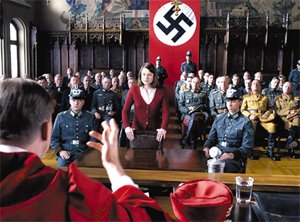 Germany's entry, Sophie Scholl: The Final Days, deserves a place next to A Man for All Seasons, Chariots of Fire, and others of the most profound portrayals of faith on film. Although currently only playing in select cities (with a wider release expected), this import is the definition of a film worth seeking out, even though it lost the Oscar to the South African film Tsotsi.
 Well-known in Germany, Sophie Scholl is a figure of remarkable courage, intellect, and faith. The film deals with just six days of this young woman's life—the final six days. Key members of a passive resistance anti-Nazi group known as The White Rose, Sophie (Julia Jentsch) and her brother Hans (Fabian Hinrichs) risk their lives by writing, printing, and distributing pamphlets that condemn National Socialism and a bloody war that Germany could not win.
On the morning of Feb. 18, 1943, Sophie and Hans walk into a lecture hall at the University of Munich to secretly distribute the group's sixth pamphlet before the building was flooded with students. This dangerous mission does not end well.
The film concerns itself with the short but intense period between Sophie's capture and execution. After she is jailed, Sophie faces off against Gestapo interrogator Robert Mohr (the steely Gerald Alexander Held), a Nazi true believer and atheist committed to breaking Sophie's spirit in order both to convict her and to search out her collaborators. While one might initially be frustrated at the lack of context for Sophie and her strongly held beliefs, the force of these interrogation scenes erases all misgivings.
Director Marc Rothemund and sbreenwriter Fred Breinersdorfer base their story extensively on transcripts of Sophie's interrogation and trial previously unpublished and unavailable (they were sealed away in East Germany before 1990). Never coming across as a Nazi-villain caricature, Mohr demonstrates supreme intellect and commitment to his cause—but is shocked to find himself matched by Sophie, who has intellect and willpower to spare.
Mr. Rothemund, at the helm of a technically excellent production, shows immense skill at weaving in details that inform Sophie's character but never overwhelm the production with heavy-handed exposition. We learn of her faith in quiet moments of prayer, and of the influence of her parents (remarkably, it's positive) in informing her political views. Sophie possesses a deep-seated strength of character, and her humble confidence is so unnerving to Mohr that one wonders whether the first to break will be her or him.
Sophie Scholl: The Final Days makes Sophie's moving story accessible to the rest of the world. Though the film is unrated, it contains nothing objectionable; only the intensity of the subject matter ought to give parents pause in allowing children to see it. It's a story that server as a powerful example of faith and courage in the face of great evil. Go see it.

Hiç yorum yok:
Yorum Gönder